Chatbots and helping to produce content have been a major use of artificially intelligent (AI) technology; however, AI is much more than these two areas. Today companies use AI powered analytics to add intelligence and insight to their data sources. AI powered analytics dresses the data source so that they can produce meaningful impacts; among them are predicting customer behaviour and developing the ability to automate the reporting dashboards. Providing the ability to quickly, easily and absolutely without the need of programming language to conduct data analytics.
In this blog you are going to see the top five most popular and effective AI based services being used for analytics and insights for your business, startup or product team so that you can play a role in analytics based decision making with your organisation.
Why Select Top 5 AI SaaS Tools For Analytics & Data Insights (2026 Guide)
Selecting the best Artificial Intelligence for an Analytics Tool will have a direct influence on your company's growth potential and profitability. The Number 1 choice was determined through Usability, AI Capabilities, Scalability. The first reason is that these Tools are all easily integrated into your current business model.
When you choose one of these Top 5 AI SaaS Tools, you will provide employees with the ability to make Fast Data Driven Decisions without depending on Technical Support. Investing today into AI Analytics will create Success for Tomorrow.
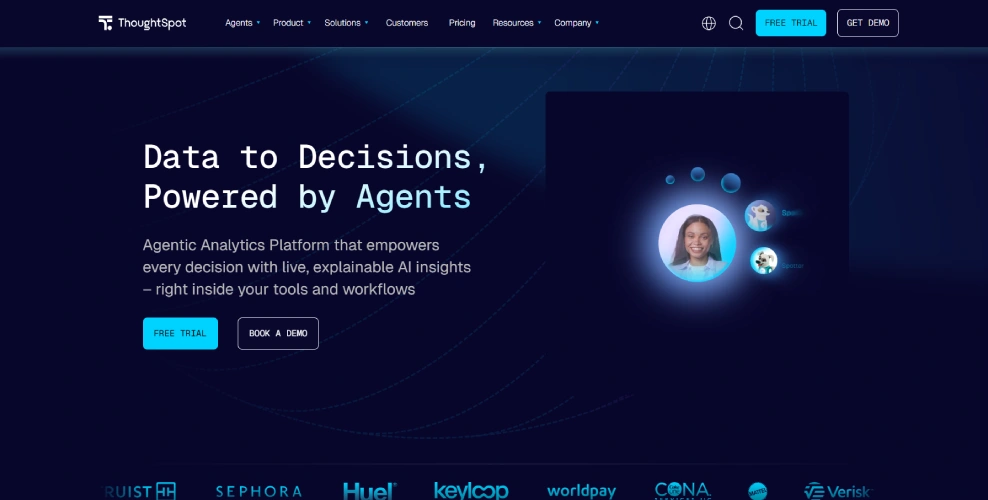
ThoughtSpot
Users can sign up and create interactive visualizations based on the information within their data warehouse(s). Automated insights are generated based on end-users' inputs into ThoughtSpot; providing companies with quick decision-making capabilities. The scalable cloud solution has an embedded reporting feature, making it available across many devices; allowing collaboration among users globally.
Why ThoughtSpot Is Useful
ThoughtSpot offers fast, easy-to-use, and visible analytic workflow support for your sales performance, customer behaviors, and operational metrics. You can create your own analytic report with ThoughtSpot's ability to join live data with existing analytics applications or dashboards that you currently utilize, allowing you to share your insights across the full spectrum of users.
Key Features
- Search-Driven Analytics
- AI-Powered Insights
- Interactive Dashboards (Liveboards)
- Seamless Data Integration
- Embedded & Mobile Analytics
- Security & Governance
- Collaboration Tools
Pros
- Intuitive Search Interface
- AI-Driven Analytics
- Real-Time Insights
- Cloud-Native Scalability
- Enterprise-Ready Security
- Embedded Analytics
Cons
- Steep Advanced Learning Curve
- Cost & Pricing Complexity
- Limited Custom Visualization Options
- Dependency on Data Quality
- Occasional Performance Challenges
 ThoughtSpot
Julius AI
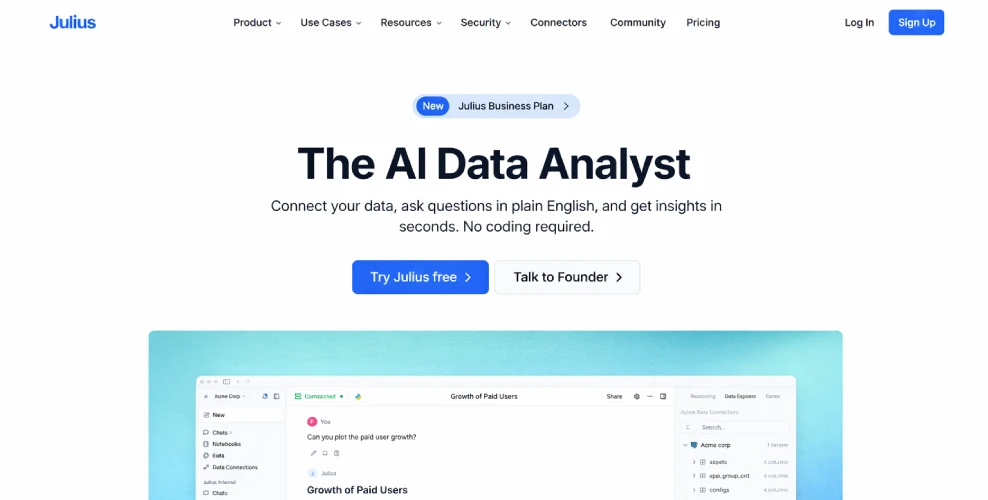
Julius uses advanced Artificial Intelligence and Large Language Models to help you build effective visualizations. With Julius, you no longer need to pre-clean or structure your data before you start creating charts, identifying trends, analyzing historical data and generating predictive forecasts. In addition to all of this, Julius will create code using SQL, Python or R on your behalf and in addition to all of this, will keep your analyses non-ambiguous and collaborative while remaining secure through encrypted connections; scheduled reporting allows you to convert chaotic data into a visual timeline for business analysts, researchers, and all team sizes in 2026; therefore, Julius is one of the most valuable assets for your organization's analytic capabilities.
Why Julius AI Is Useful
1. Makes Data Simple for Everyone:
A major part of what makes Julius AI powerful is its ability to utilize a natural language interface instead of requiring programming languages (SQL, Python, etc.) and complex data calculations/queries. Instead, just ask your question ... and Julius will return some form of insight, visualization, or summary almost instantaneously This feature will be helpful for business users so they don't have to wait for someone else to solve their problems (i.e., an analyst/engineer, etc.) - they will be able to receive their own answers quickly and easily.
2. Speeds Up Decision-Making:
Because Julius connects directly and in real-time to your live data sources and processes information in real-time, it reduces the time spent exporting files, cleaning data, and visualizing data so you can easily access actionable insights within minutes of requesting them. Teams that use Julius are able to utilize its functions to analyze the performance of their associates, track the effectiveness of their marketing campaigns, analyze market trends, and even automate the scheduling of daily, weekly, and monthly updates via email or Slack - therefore, saving them a significant amount of time each month.
Key Features
- Natural Language Data Chat
- Automatic Visualizations
- Ask Questions in Plain English
- Live Data Connections
- Predictive Analytics & Forecasting
- Scheduled Reporting
- AI Generated Code
- Collaboration & Sharing
- Security & Privacy
Pros
- Super Intuitive
- Quick Insights
- Versatile Data Support
- Automates Prep Work
- Useful for Teams
- Predictive Power
Cons
- Free Tier Limitations
- Occasional AI Errors
- Not Full Dashboard Replacement
- Dependent on Clear Data
- Internet Required
 julius.ai
Microsoft Power BI
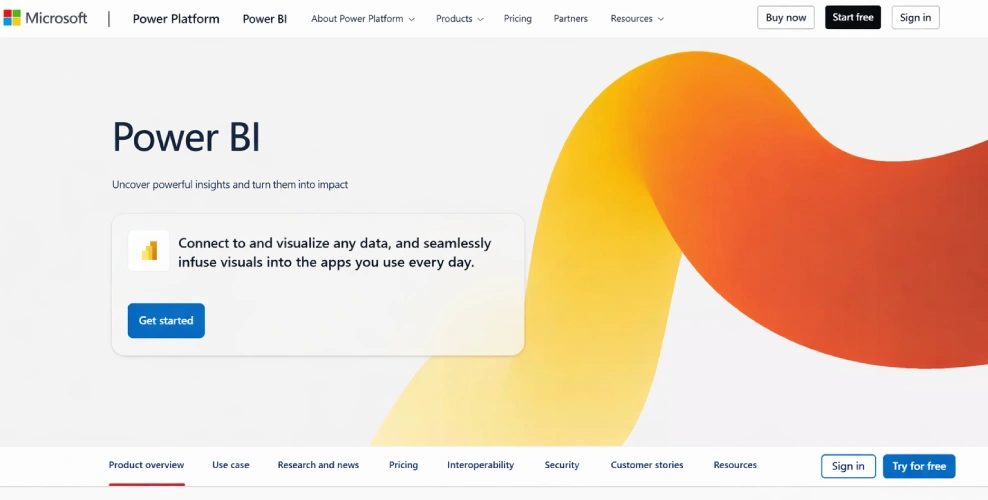
Power BI is a powerful tool that can connect to a variety of data sources including excel files, cloud services, databases, and third party applications. The software will take large and complex data sources and create simple to understand and visually appealing reports that can be used by businesses for improved decision making. Power BI has large built in capabilities for artificial intelligence and has strong integration with other Microsoft products which has made it one of the top tools for companies looking for analytics and data insights by 2026.
Why Microsoft Power BI is Useful
Every day businesses are creating a huge amount of data. Examples of this data include; Sales Reports, Marketing News, Financial Records, and Customer Experience. If this is not analyzed properly this data is worthless. Power BI is used by organizations to:
- Convert raw data into interactive dashboards
- Identify trends and patterns quickly
- Make faster, data-driven decisions
- Share insights across teams securely
- Monitor KPIs in real time
Key Features
- Interactive Dashboards
- Multiple Data Source Integration
- AI Powered Insights
- Real Time Data Monitoring
- Advanced Data Modeling
- Secure Data Sharing
- Mobile Accessibility
- Cloud & On Premise Deployment
Pros
- Easy to Use Interface
- Strong Integration with Microsoft Products
- Powerful Data Visualization
- Affordable Pricing for Small Businesses
- Scalable for Enterprise Use
- Regular Updates
Cons
- Learning Curve for Advanced Analytics
- Premium Features Require Paid Plans
- Performance Issues with Large Datasets
- Some Customization Requires Technical Knowledge
 powerbi.microsoft.com
Mixpanel
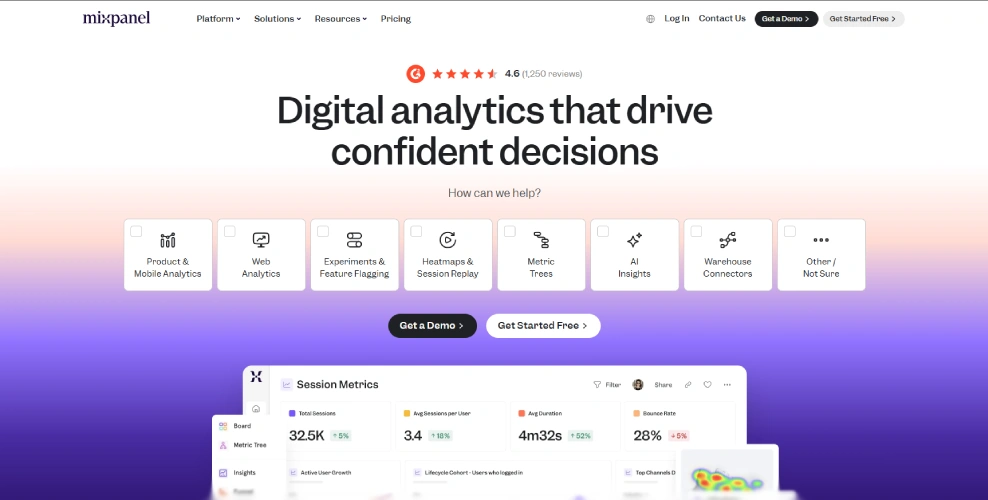
Mixpanel, founded to create smarter decisions with meaningful data, allows organizations to analyze customer engagement, retention, and conversion through real-time metrics. Regardless of whether you have a retail store, SaaS platform, or mobile application, Mixpanel provides insights into why customers are abandoning you and what can be done to improve your customers’ experiences.
Why Mixpanel is Useful
Simply having data will not allow a business to grow, as there must be actionable insights. The way Mixpanel is helpful is that it is an event-based tracking system and therefore provides clear visibility as to how an individual interacts with a product; therefore showing where the gaps reside when users leave a webpage (for example).
Key Features
- Event Based Tracking
- Funnel Analysis
- Retention Reports
- User Segmentation
- Real Time Analytics
- A/B Testing Insights
- Cohort Analysis
- Integration Capabilities
Pros
- Deep User Behavior Insights
- Powerful funnel and retention analysis
- Easy-to-understand dashboards
- Strong segmentation capabilities
- Real-time data tracking
- Scalable for startups and enterprises
Cons
- Can be expensive for large-scale data usage
- Requires technical setup for advanced tracking
- Learning curve for beginners
- Limited traditional website traffic metrics compared to basic analytics tools
 mixpanel.com
Polymer
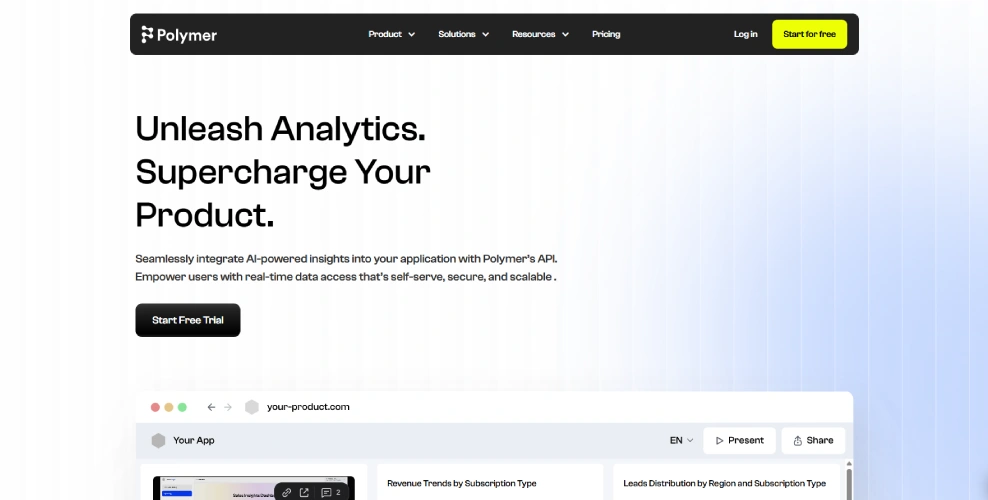
Polymer is one of the more popular tools that are being used by small-to-medium companies, new companies, and marketing departments to access immediate and actionable business intelligence without having an entire analyst team employed. Using an easy-to-use software interface, Polymer gives users the ability to upload their spreadsheet or connect to their data source(s) to produce reports that can be used to present professional results immediately.
Why Polymer is Useful
Many organizations have historically struggled to make sense of their data using traditional BI tools, which are often complex and time consuming to use. Polymer breaks down those barriers and allows anyone, including non-technical users, to easily and quickly analyze their data.
Key Features
- Instant Data Visualization
- No-Code Analytics
- Interactive Dashboards
- Data Source Integration
- Custom Branding
- Secure Sharing Options
- Automated Data Updates
Pros
- Very Easy to Use
- No Technical Skills Required
- Fast Dashboard Creation
- Affordable for Small Businesses
- Cloud-based and accessible anywhere
- Great for spreadsheet-based reporting
Cons
- Limited advanced analytics compared to enterprise BI tools
- Fewer customization options than high-end platforms
- May not replace full-scale data warehouse solutions
 polymersearch.com
Comparison
| Tool | Primary Strength | Key AI Feature | Target User |
|---|---|---|---|
| ThoughtSpot | Self-service search | Spotter AI Analyst | Business Teams |
| Julius AI | AI data analysis | Natural language analytics | Analysts & Researchers |
| Microsoft Power BI | Microsoft ecosystem integration | Copilot AI insights | Large enterprises |
| Mixpanel | User behavior tracking | AI product analytics | Product teams |
| Polymer | No-code dashboards | Automated visualization | Small businesses |
Conclusion
As the year 2026 approaches, organizations have transitioned away from traditional business intelligence (BI) reporting tools like Microsoft Excel or IBM Cognos and toward integrated, automated, artificial intelligence (AI)-enabled analytics solutions that offer new ways to analyze and leverage their data. Some examples include: ThoughtSpot (AI Search Analytics), Julius AI (AI Predictive Forecasting), Microsoft Power BI, Mixpanel, and Polymer, among others. Organizations can also leverage event-driven tracking to measure the success of their actions much faster and provide on-the-fly dashboards for visualization of their data.
Artificial Intelligence (AI) and the automation of processes have made it possible for businesses to find scalable solutions that are customized according to the needs of their organizations. The power of AI (artificial intelligence), the speed of automated analysis processes, and real-time report generation are providing businesses with ways to improve operational efficiency, provide superior customer service, and stay ahead of their competitors in today’s increasingly digital world.