Website loading speeds have become one of the most crucial considerations in understanding website interactions and search engine ranking of websites. Today, internet users demand websites to load in seconds, and failure to deliver in accordance with such demands gives rise to the possibility of users abandoning websites without taking any further action. Website loading speeds are also core in determining search engine visibility.
To achieve optimal performance, website owners should have a method to determine and improve the speed. Website speed optimization tools have a critical part in this process. They help to determine bottlenecks in the performance of websites in terms of slow servers, poor image optimization, too many scripts, and poor code. They also offer information that makes it easy to improve website speed.
In this blog, we will see the top five website speed optimization tools which is used by the people for analyse, test, and optimize their website for speed. To increase your experience as well as your search engine optimization, you need to keep yourself updated with the latest information related to website speed optimization tools, which will be provided through this article.
Why These Five Website Speed Optimization Tools Are Selected as the Best
These five website speed optimization tools are chosen because they are good. They help make websites load faster. People, like them because they work well. The reason these website speed optimization tools are selected as the best is that they make a difference. These website speed optimization tools are the best because they are very useful. They are chosen for a reason, which is to help websites run smoothly and quickly and that reason is that these website speed optimization tools are the best.
These website speed optimization tools are good because they work, not because of what they say they can do. The main thing I looked at was how well each tool really helps make websites load faster makes the site better for people to use and helps with search engine optimization. I thought about things like how accurate they are how easy they are to use how helpful their advice is, how well they work for big websites and if other people in the industry trust them. These tools are useful, for people who make websites people who own websites and digital marketers who want to keep their websites running. Website speed optimization is important. These tools can help with that.
1. Proven Real-World Usability
These tools work well when they look at live websites and see how they do in the real world. They check how fast pages load on devices, browsers and internet connections and they show us what is really slowing things down like big pictures, scripts that need to be fixed and servers that are too slow. Tools like Google PageSpeed Insights and WebPageTest give us ideas that we can use so we can make changes that really work and that we can measure. Google PageSpeed Insights and WebPageTest are better, than tools that just give us scores that do not really mean anything because they give us results that we can trust when we are looking at websites.
2. Strong Industry Adoption and Trust
When you are choosing tools, one important thing to think about is how many people use them. Lots of developers SEO experts and digital agencies use these tools. These tools have a reputation because they are accurate, consistent, and relevant. They have been this way for a time. The people who make these tools keep updating them so they work well with the new technologies, better performance, and search engine requirements.
These tools are trusted by professionals. So, when they suggest something, it means a lot. This helps website owners feel confident when they are trying to make their website work better and get rankings. Website owners like to use these tools because they are good at helping them improve performance and rankings of their website and these tools are, for digital agencies and SEO experts and developers.
3. Focus on SEO and User Experience
The speed of a website is important for search engine rankings. How happy users are. These tools look at things like how it takes for a page to load how easy it is to interact with and how stable the website looks. This stuff matters because it can make people leave your website or stay and look around. When you make your website faster and easier to use at the time you can get more people to visit and keep them from leaving.
The tools also help with something called Core Web Vitals, which is what Google uses to decide if a website is good or not. So, it is not about making your website fast it is also about making sure it meets Googles standards for search engine rankings which are always changing. Website speed and Core Web Vitals are important, for making a website that people like. That Google likes too.
4. Scalability and Performance Analysis Capabilities
These tools are useful. Can be used for many things. They can test a personal blog or a big website that sells things online. The tools give us a lot of information that helps websites work well when things get busy or when they are not so busy.
- Testing website performance on both mobile and desktop devices
- Evaluating speed from multiple locations and network types
- Identifying server-side and front-end performance issues
- Looking at situations, with a lot of traffic without losing any accuracy when we are analysing high-traffic scenarios
5. Actionable Insights and Future Readiness
These tools do more than measure how fast a website is. They also give you ideas, on how to make your website work better and get ready for problems that might come up in the future. The ideas they give you help you use methods to make your website like making images smaller simplifying scripts storing things in a cache or using a content delivery network also known as a CDN to deliver your websites content.
- Clear, actionable optimization recommendations
- Compatibility with evolving performance metrics like Core Web Vitals
- Support for modern frameworks, progressive web apps, and advanced technologies
Thus, these five tools not only provide accurate information regarding performance problems but also allow website owners the ability to make relevant modifications that can lead to improvements in not only the functionality of the web page but also user experience. These instruments with their accuracy, scalability, as well as future-readiness, comprise the best methods currently available.
Website Performance Tools Guide
Google PageSpeed Insights
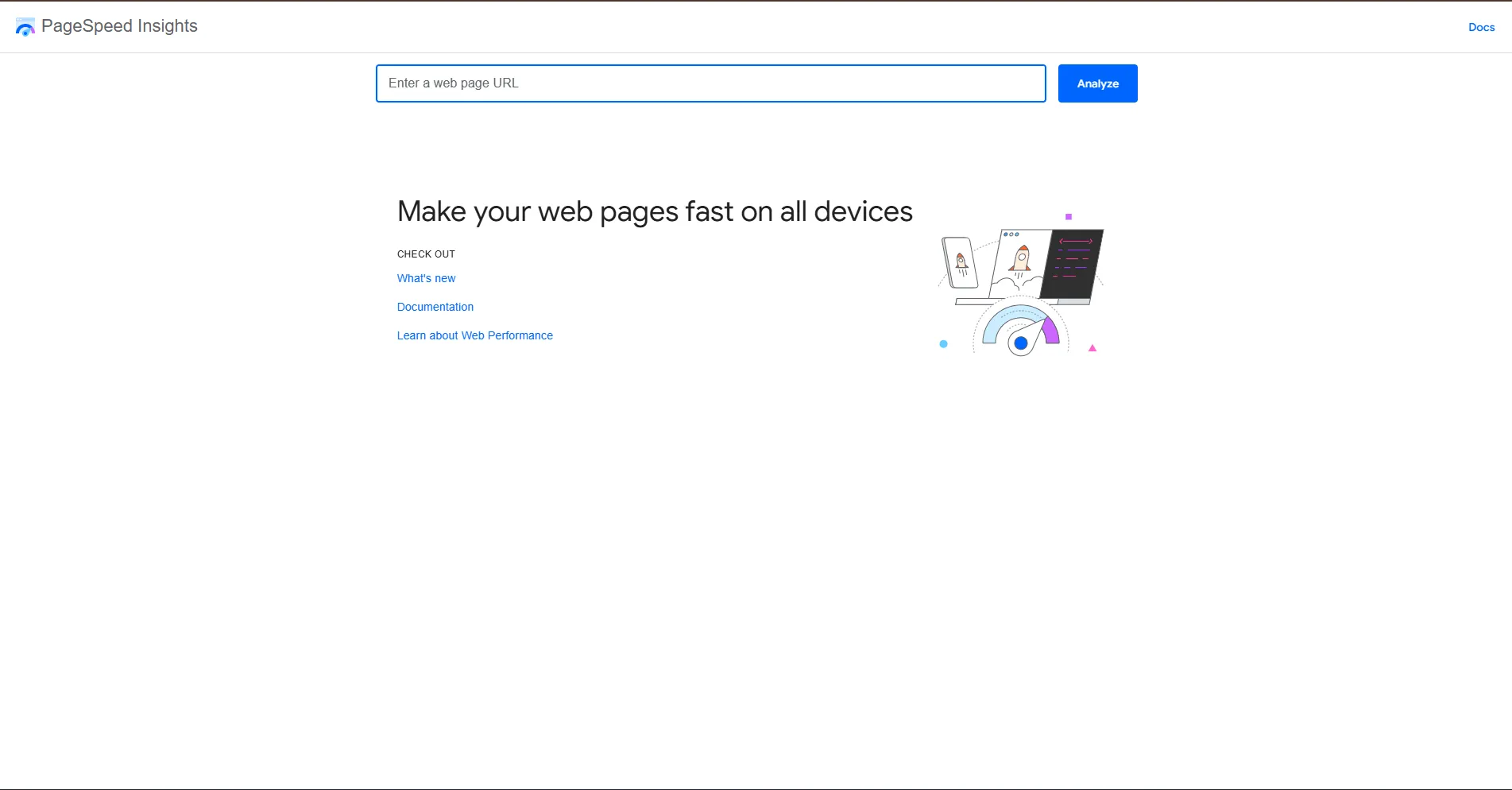
Google PageSpeed Insights (PSI) is one of the highly popular web applications that can be freely used by everyone to determine the performance of any webpage not only in mobile devices but also in desktop devices. The unique feature of PSI is that it not only focuses on technical aspects of web performance but also takes into consideration real user feedback that is provided by the Chrome User Experience Report. Thus, it gives the users an all-in-one report regarding the performance of page. Core Web Vitals like Largest Contentful Paint (LCP), First Input Delay (FID), or Cumulative Layout Shift (CLS) hold very important positions in assessing web performance. All these factors are directly related to user experience as well as search engine optimization. The report contains several recommendations. These recommendations include image optimization, browser caching, eliminating unnecessary render-blocking resources, or server responses optimization. As it is a Google product, it directly influences the probability of the page being displayed in the search engine result page.
- Pros: Free and accessible to the public, blends laboratory data with real-user experience data, focus on Core Web Vitals and SEO metrics, offers advice on speed and UX
- Cons: Weeknight specials may oversimplify complex technical testing personalization limitations, scores may vary based on real user traffic
You can explore more details on the official website:
Google PageSpeed Insights Official Site:
https://pagespeed.web.dev/
GTmetrix
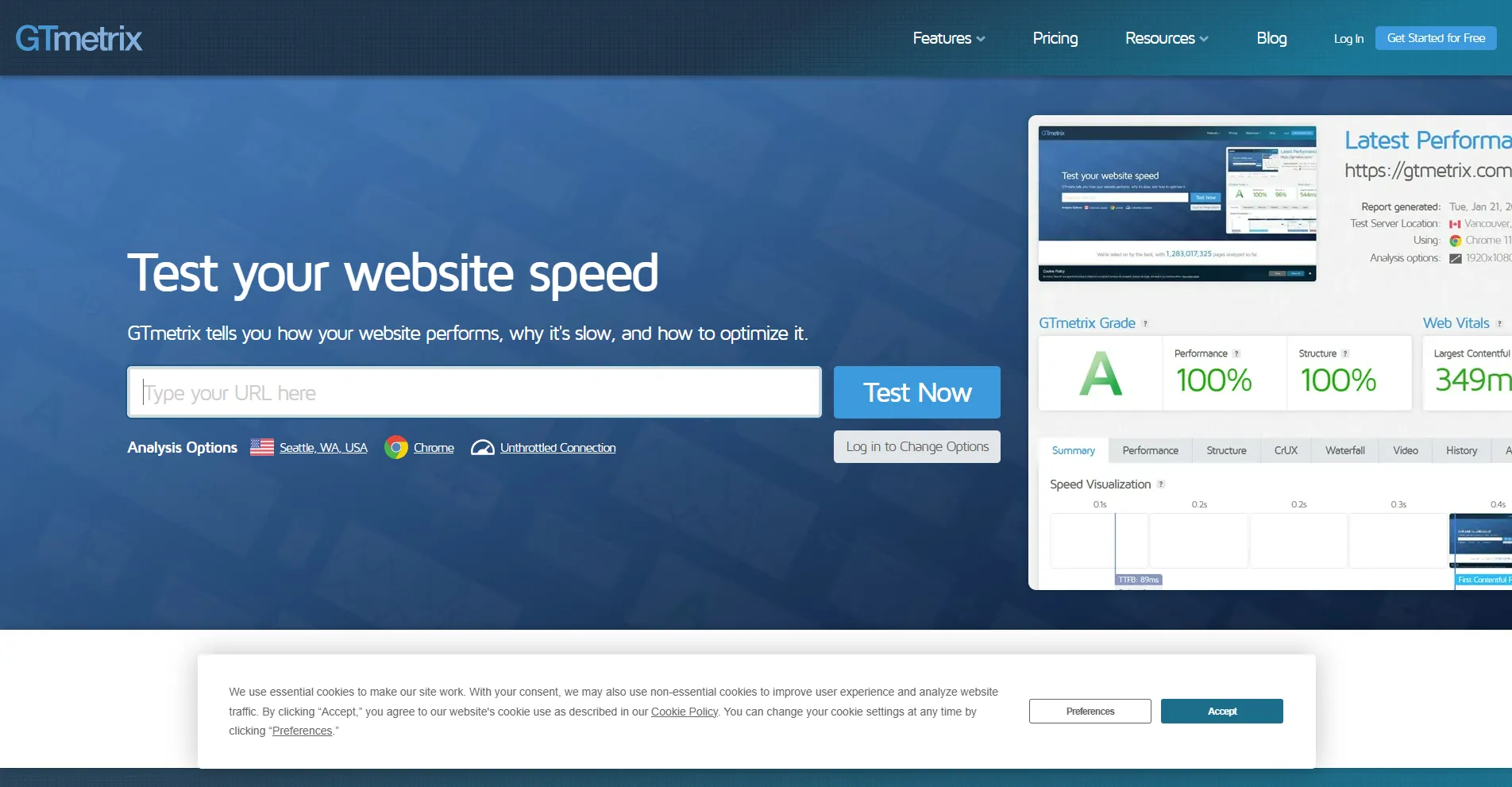
GTmetrix is a very useful online utility for a detailed analysis of performance. It blends the results of Google’s Lighthouse metrics and its own performance scoring system to allow for a detailed assessment of loading times and resource usage. A major important and unique feature of GTmetrix is that it offers a waterfall chart that shows the sequence and time involved for each element’s loading on a webpage. This will enable a more accurate determination of those processes that are taking long on the client side and which images are loading too large on the server side. GTmetrix provides historical graph functionality so that the user will be able to measure the improvement made on the loading speed on the webpage. The facilities provided for the testing of a webpage with GTmetrix are quite flexible and useful if your webpage targets users from all around the globe.
- Pros: Detailed waterfall charts and resource breakdowns, historical performance tracking and comparison, multiple test locations and browser options, clear optimization suggestions with explanations
- Cons: Free plan has limited test locations, can be overwhelming for beginners due to technical depth, advanced features require a paid subscription
You can explore more details on the official website:
GTmetrix Official Site:
https://gtmetrix.com/
WebPageTest
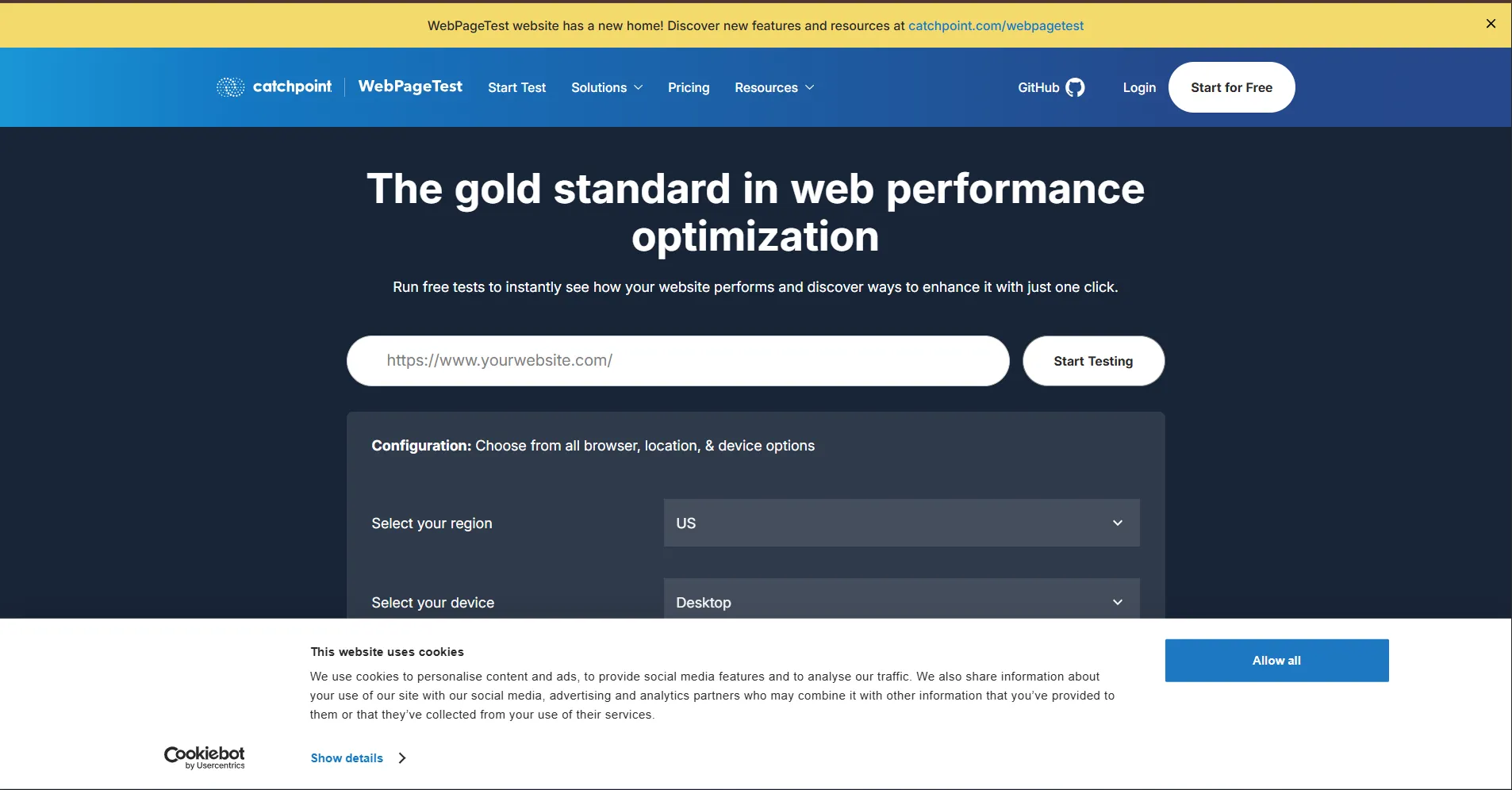
WebPageTest is an advanced website speed testing tool. It is widely used amongst developers and performance engineers. It provides an extensively customizable speed test environment, including geographical regions, devices, and network speeds. It provides a realistic insight into the performance metrics as perceived by users across the world. It allows users to monitor video captures and filmstrip analyses of page loads over time. It is used to detect performance bottlenecks encountered by users regarding the time allotted to rendering, receiving resources, and executing scripts. It is an apt tool to use on a large-scale website or application that requires a detailed performance review.
- Pros: Highly detailed and customizable testing, supports multiple locations, devices, and network speeds, visual page load analysis with video and filmstrip, free and open-source
- Cons: Interface can be complex for beginners, requires technical knowledge to interpret advanced metrics, test setup can be time-consuming
You can explore more details on the official website:
WebPageTest Official Site:
https://www.webpagetest.org/
Pingdom Website Speed Test
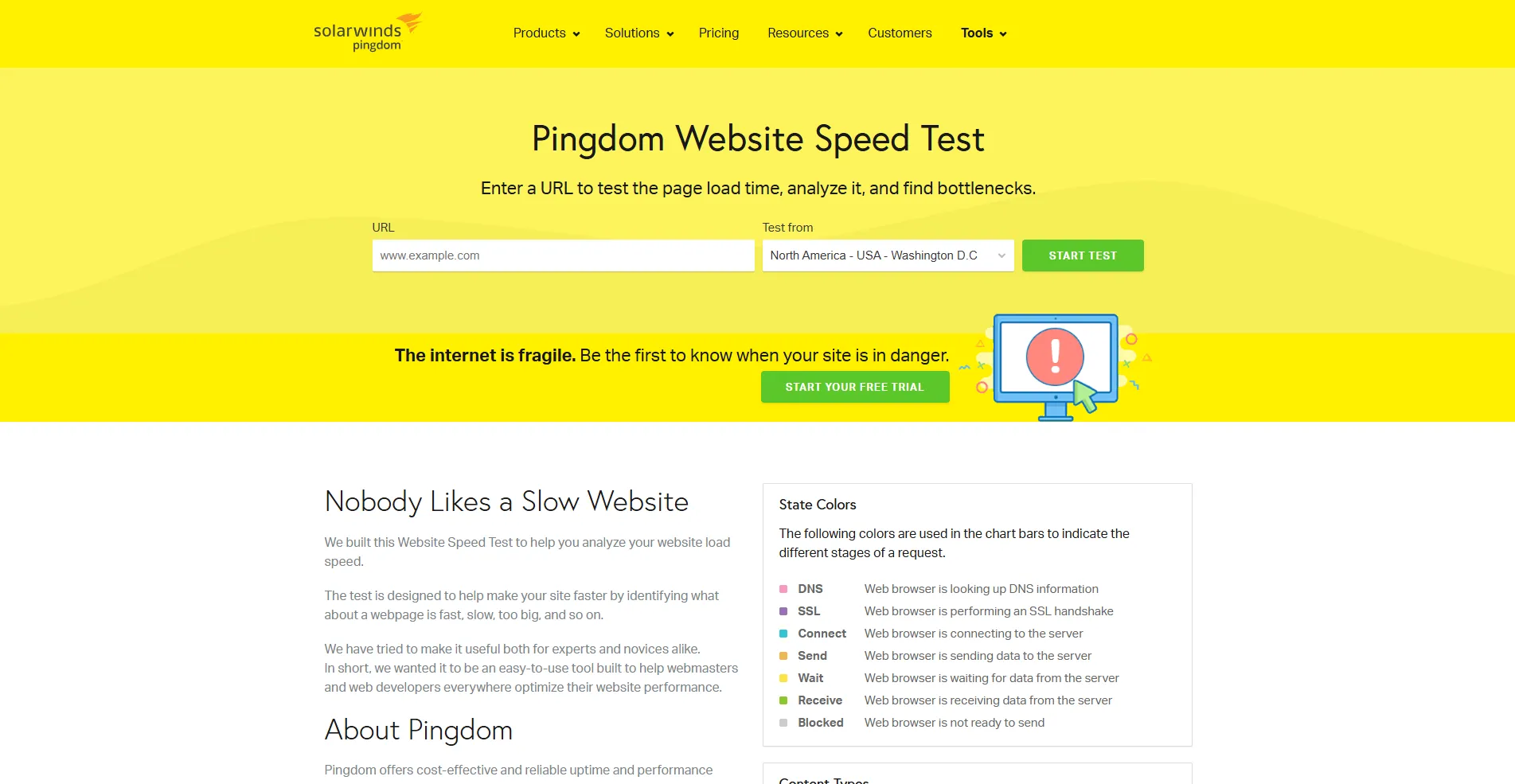
Pingdom is an online facility for testing the speed of a website, which gives a quick diagnosis of the speed of the page, constituents, and overall speed of the website. Pingdom is much popular for its simplicity and ease of use, which is a great facility for website owners who are waiting to get a quick diagnosis of the speed of their website without needing much technical expertise. Pingdom also tests the speed of a website from different geographic locations around the world, giving information about the constituents of a website that are loading slowly, which helps a user to work on the speed of images, scripts, and the server speed of a website. Additionally, the facility also provides the option for tracking the down time of a website.
- Pros: Simple and intuitive interface, global location testing, performance grades and detailed element breakdowns, uptime monitoring and alerting features
- Cons: Free version has limited test locations, less detailed than developer-focused tools, recommendations are more general, not highly technical
You can explore more details on the official website:
Pingdom Website Speed Test Official Site:
https://tools.pingdom.com/
Lighthouse (Chrome DevTools)
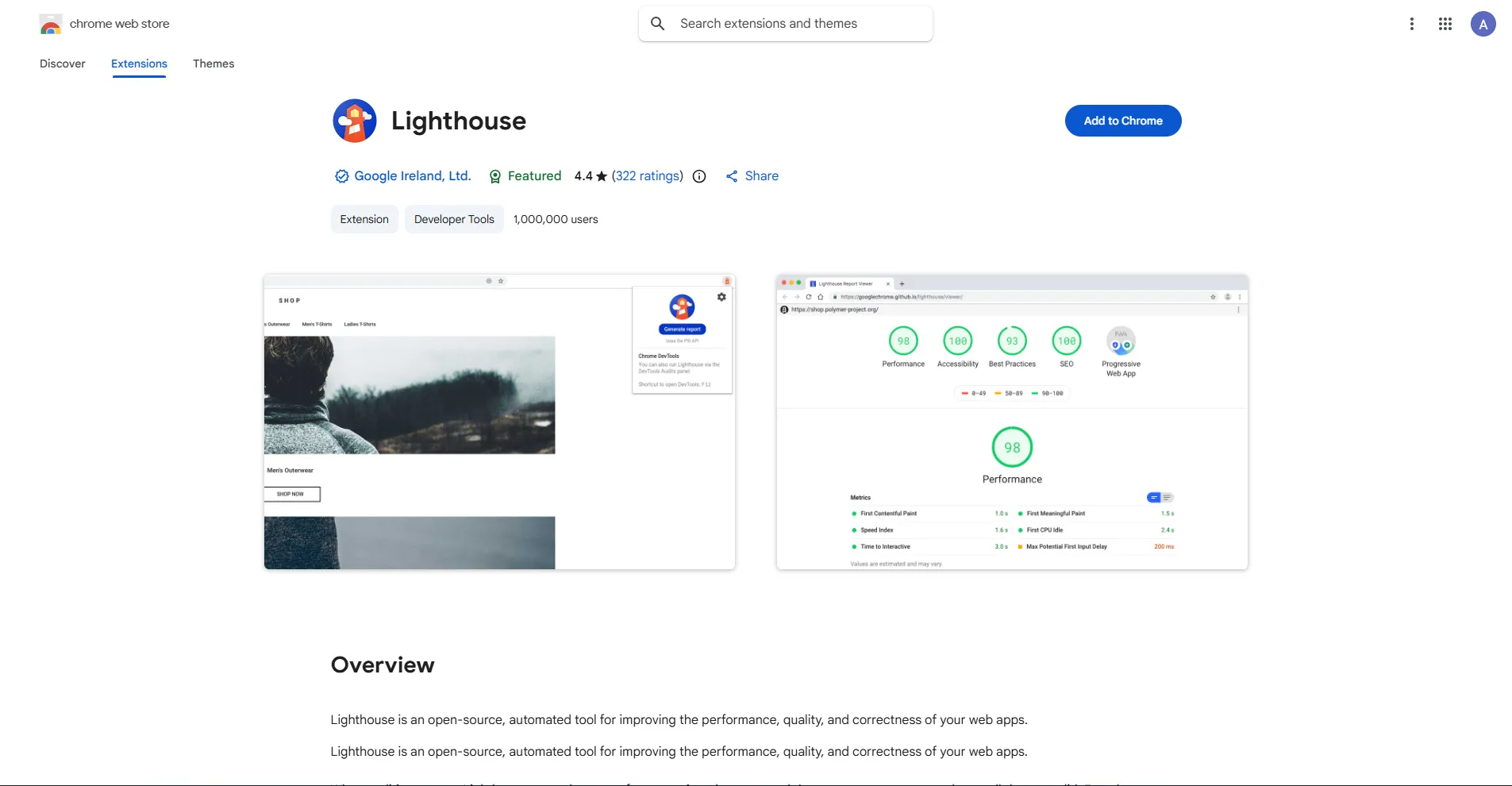
The Chrome DevTools-based open-source auditing tool, named Lighthouse, is very efficient for performance analysis. This helps the web developer in performance, accessibility, SEO, as well as best practice audits. This tool can analyze performance, accessibility, SEO, as well as best practices, all in one go. The performance scoring, optimization recommendations, caching, image optimization, unused JavaScript, as well as rendering blocking resources, can all be achieved using this software. What is most interesting about this software is the ability to conduct the test right in the browser. This is a very efficient tool for web application optimization.
- Pros: Built into Chrome, no signup required, covers performance, accessibility, SEO, and best practices, provides actionable recommendations for speed and optimization, ideal for developers working directly in the browser
- Cons: Requires Chrome and basic technical knowledge, lacks multi-location testing out of the box, no built-in historical tracking
You can explore more details on the official website:
Lighthouse (Chrome DevTools) Official Site:
https://developer.chrome.com/docs/lighthouse/overview/
Comparison
| Tool | Key Feature | Best For | Pricing |
|---|---|---|---|
| PageSpeed Insights | Core Web Vitals analysis | SEO & user experience | Free |
| GTmetrix | Waterfall charts & historical tracking | Detailed performance analysis | Free / Pro $14.95/mo |
| WebPageTest | Multi-location & device testing | Developers & advanced testing | Free |
| Pingdom | Simple speed test & uptime monitoring | Quick insights & small websites | Free / Paid $10/mo |
| Lighthouse | Performance + SEO + accessibility audits | Developers testing in Chrome | Free |
Conclusion
The need to optimize the speed of a website is not something businesses can choose or opt out of. If the sites they use tend to load slowly, it not only irritates their visitors, but it also impacts the conversion rates, user engagement, and the organic traffic that the sites receive. It becomes possible to fix this using the proper tools.
The five tools reviewed in this article – Google Page Speed insights, GTmetrix, WebPageTest, Pingdom, and Lighthouse – have their respective benefits, ranging from SEO audits to developer testing. With the help of these tools, website owners and digital marketers are equipped to take informed actions and create a smooth and optimized browsing environment.
Overall, the ability to integrate all these tools will enable you to analyze and optimize your website as well as monitor your website so that your site stays competitive and fully search engine and human-optimized and friendly as well. A faster website results in a happy and engaged audience and visibility on search engines as well.